IN THE LABORATORY
- Mushroom “farming” began as a way to ensure a consistent and sustainable supply of our favourite fungi.
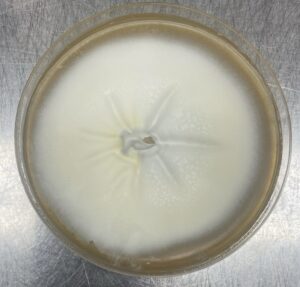
- In our laboratory, carefully selected strains of mushrooms are initially cultivated in Petri dishes.
- After a week or 2, segments of mycelium are used to inoculate jars of specially selected grain.
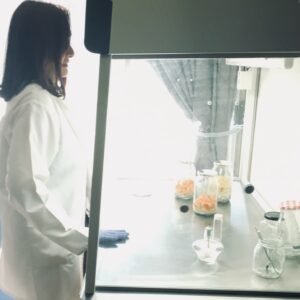
- Work is carried out in a laminar flow hood which is an aseptic enclosed workstation where work can be carried out freely without contamination issues.
- Mycelium is the term that is used to refer to the threadlike strands that the fungus produces as it colonises (consumes) the substrate (its food) in order to grow and develop to maturity.
- In the photo of the petri dish below, one can clearly see the mycelium spread across the surface of the agar (food source) in the petri dishes.
COLONISING GRAIN
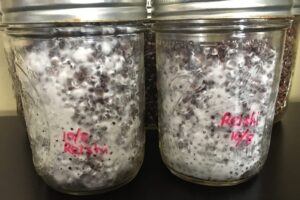
- It takes an additional 2 -3 weeks for the grain to be fully colonised.
- Once the grain is colonised, it is referred to as grain spawn or mycelium on grain (MOG).
MATURATION INTO FRUITING BODIES
- Mycelium On Grain is then used as the inoculum for more complex substrates such as supplemented wood-based substrates (for Reishi and Lion’s Mane)
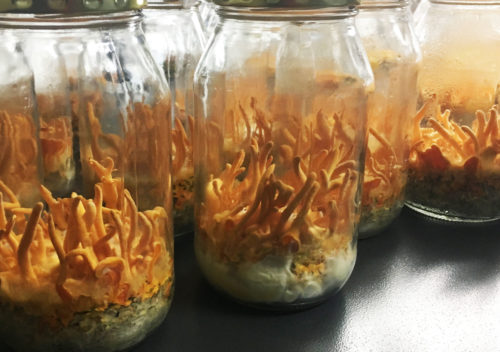
- However, for Cordyceps, supplemented rice is used as the final fruiting substrate.
- The mushrooms are encouraged to mature and fruit in their respective grow rooms, where specific parameters of light, air, humidity and temperature are carefully controlled for approximately 2 to 3 months until the fruiting bodies mature and can be harvested.
- What we commonly refer to as the mushroom – is actually the fruiting body of the mature fungus.
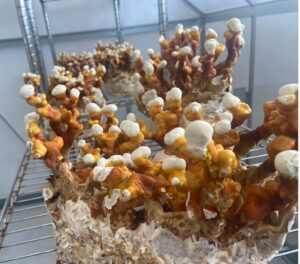
HARVESTING THE MATURE FRUITING BODIES
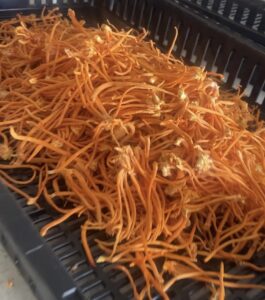

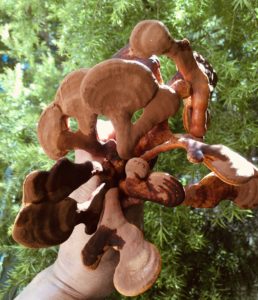
DRYING THE FRUITING BODIES
- When mature, the fruiting bodies are harvested and while some of the species like Reishi can be sun – dried; the Cordyceps and Lion’s Mane mushrooms are dried in a commercial dryer.

CREATING THE EXTRACTS
- Once the mushrooms are dried, they are subject to the hot water and alcohol extraction processes in order to produce our extracts
